A paper on our work about how people think about constraint programming has just been published in anticipation of the prestigious Conference on Principles and Practice of Constraint Programming (CP 2022). The paper is accessible through this address.
The work takes place at the intersection of Human-Computer Interaction and Constraint Programming.
We analyzed how non-experts tried to solve constrained programming problems.
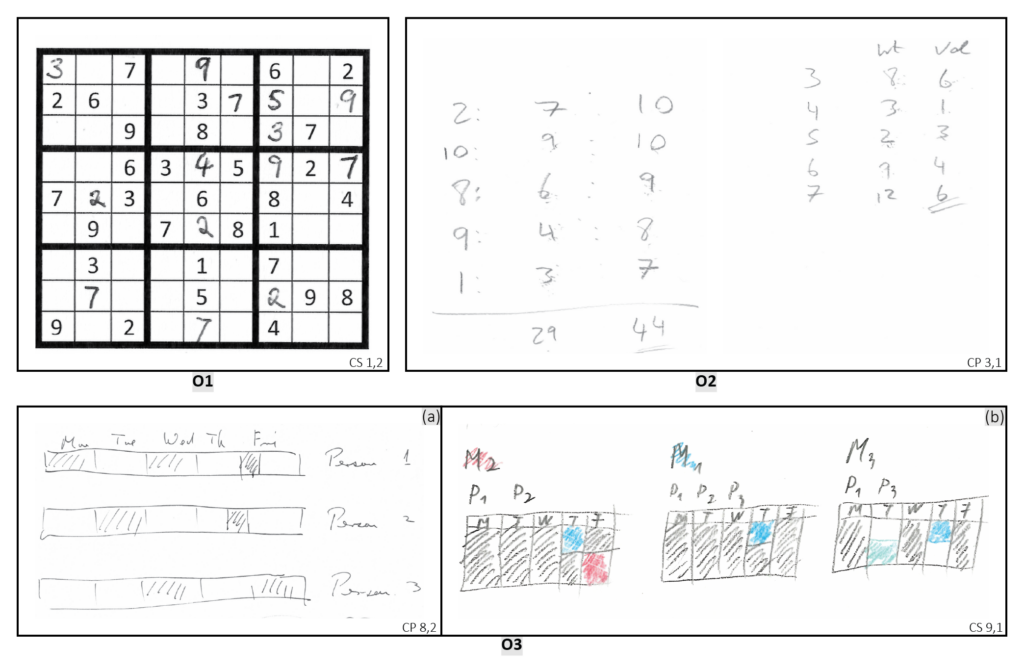
This is work with Ruth Hoffmann, Xu Zhu, and Özgür Akgün, from the School of Computer Science at the University of St Andrews (my previous main institution).
This follows our previous work on how people visually represent discrete contraint problems (at the IEEE Transations on Visualization and Computer Graphics).
Dr Hoffmann has also presented at ModRef a synthesis on both pieces of work.
Finally, the SACHI group posted a blog post with a bit more information.
 Miguel Nacenta