Please, come to Capri to discuss MDEs with us!
============================================================================================
Workshop on Infrastructure and Design Challenges of Coupled Display Visual Interfaces PPD’12
http://sachi.org.uk/ppd12/
============================================================================================
In conjunction with AVI’12, Capri, Italy, May 25, 2012
============================================================================================
Following on from the very successful PPD’08 and PPD’10 workshops at previous AVI conferences.

Keywords: Multi-display environments, MDE infrastructure, Coupled Displays, Interaction Techniques
DATES:
Submission deadline: March 30th
Acceptance notification: April 5th
GOAL:
The objective of PPD’12 is to bring together researchers active in the areas of multi-display user interfaces to share approaches and experiences, identify research and deployment challenges, and envision the next generation of applications that rely on visual interfaces that can spread across multiple displays. Among the possible outcomes of the workshop are a book and a grant application.
TOPICS (including but not restricted to):
-Understanding the design space and identifying factors that influence user interactions in this space
-Developing evaluation strategies to cope with the complex nature of multi-display environments
-Understanding the implications that display is shaped by human activity into an ecological arrangement and thus an ecology
-Ethnography and user studies of visual interfaces relying on coupled displays
-Examples of applications of coupled display interfaces in real-world applications
-Social factors that influence the design of suitable interaction techniques for shared and private displays
-Exploring interaction techniques that facilitate multi-display interfaces
-Novel input mechanisms for both private and public multi-touch devices as part of multi-display environments
-Techniques for supporting input re-direction and distributing information between displays
-SDK/APIs, IDEs, and hardware platforms for the development of coupled display visual interfaces
MOTIVATION:
An increasing number of interactive displays of very different sizes, portability, projectability and form factors are starting to become part of the display ecosystems that we make use of in our daily lives. Displays are shaped by human activity into an ecological arrangement and thus an ecology. Each combination or ecology of displays offer substantial promise for the creation of applications that effectively take advantage of the wide range of input, affordances, and output capability of these multi-display, multi-device and multi-user environments. Although the last few years have seen an increasing amount of research in this area, knowledge about this subject remains under explored, fragmented, and cuts across a set of related but heterogeneous issues. We invite researchers and practitioners interested in the challenges posed by infrastructure and design.
DETAILS:
The workshop will be for a full day and structured to provide maximum time for group discussion and brainstorming. Each participant will be expected to be familiar with all position papers (which will be available to them well in advance of the event). The workshop will structured around four sessions (separated by the morning break, lunch and afternoon break). In the first session the participants will briefly introduce themselves and engage in a brainstorm to outline key discussion topics for the two midday sessions. In the second and third session the group will be divided into sub-groups moderated by the workshop organisers to have focused discussions on some of the key topics identified earlier. In the fourth session the group will reconvene to summarise the advances identified in the breakout discussions.
ORGANIZERS:
Alan Dix, University of Birmingham/TALIS
Miguel Nacenta, University of St Andrews
Aaron Quigley, University of St Andrews
Tom Rodden, University of Nottingham
SUBMISSION INSTRUCTIONS:
The position papers should be prepared according to the ACM SIGCHI Format (2 column, 10 point font size) and should not be longer than four pages. The submissions can present summarizing, on-going or speculative work.
Send submissions toppd12@cs.st-andrews.ac.uk before the end of March 30th.
Submissions will be peer reviewed by a international program committee of multi-display and surface computing experts. Submissions do not have to be anonymous.
PROGRAM COMMITTEE:
Dzmitry Aliakseyeu – Philips Research Europe
Simone DJ Barbosa – Pontifical Catholic University of Rio de Janeiro
Shlomo Berkovsky – NICTA
Alan Dix – University of Birmingham/TALIS
Adrian Friday – University of Lancaster
Rodger Lea – University of British Columbia
Alessio Malizia – Universidad Carlos III de Madrid
Miguel Nacenta – University of St Andrews
Kenton O’Hara – Microsoft Research
Aaron Quigley – University of St Andrews
Stuart Reeves – University of Nottingham
Tom Rodden – University of Nottingham
Michael Rohs – Ludwig-Maximilians-Universität München
Lucia Terrenghi – Google
Frederic Vernier – Université Paris-Sud
Jim Wallace – University of Waterloo
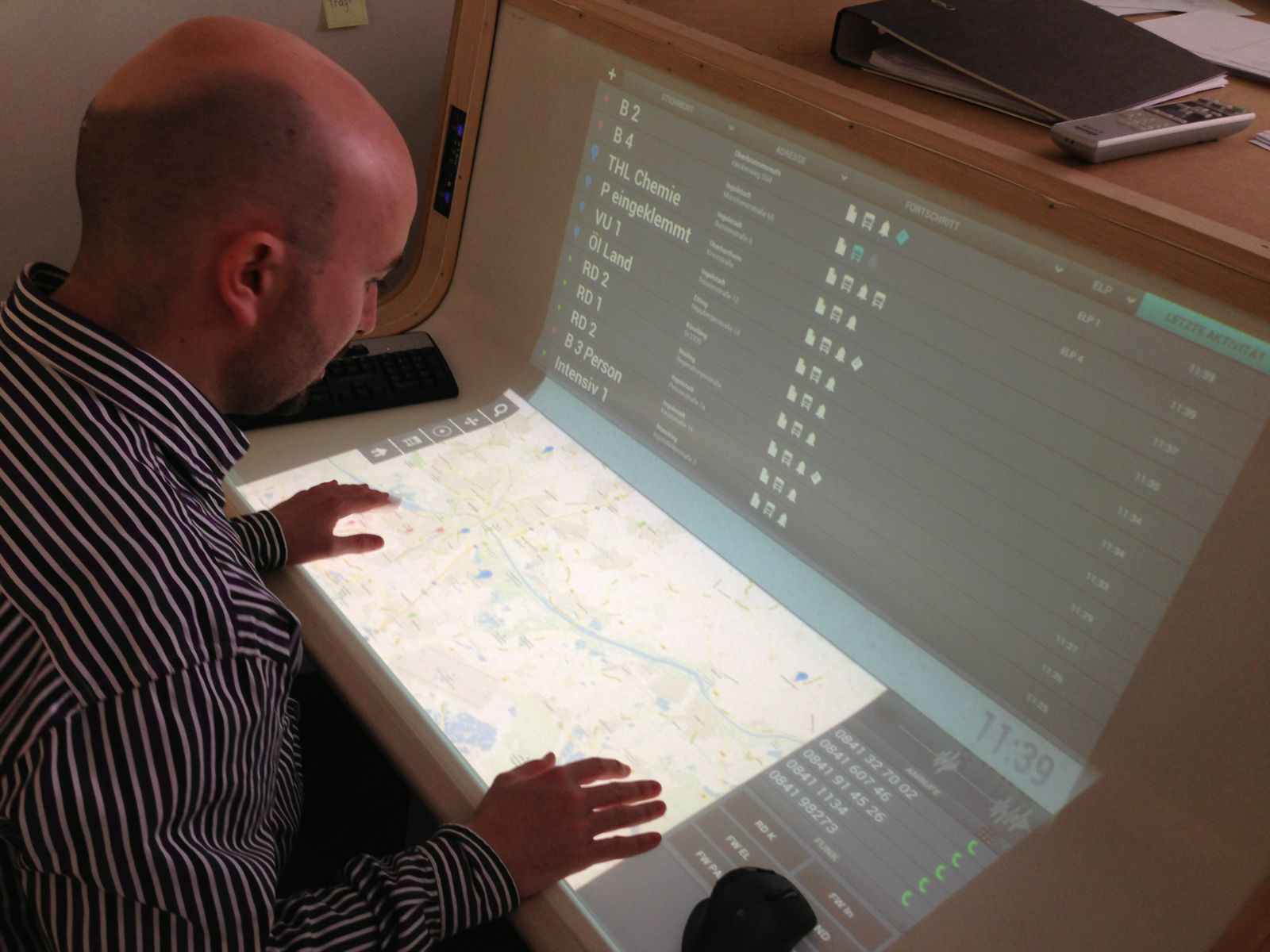
 In Munich we visited the Media Informatics and Human-Computer Interaction Group, invited by Andreas Butz. It was really nice to see finally the curve (in the picture), among lots of other excellent research, including work by Alice Thudt, a current collaborator of Uta.
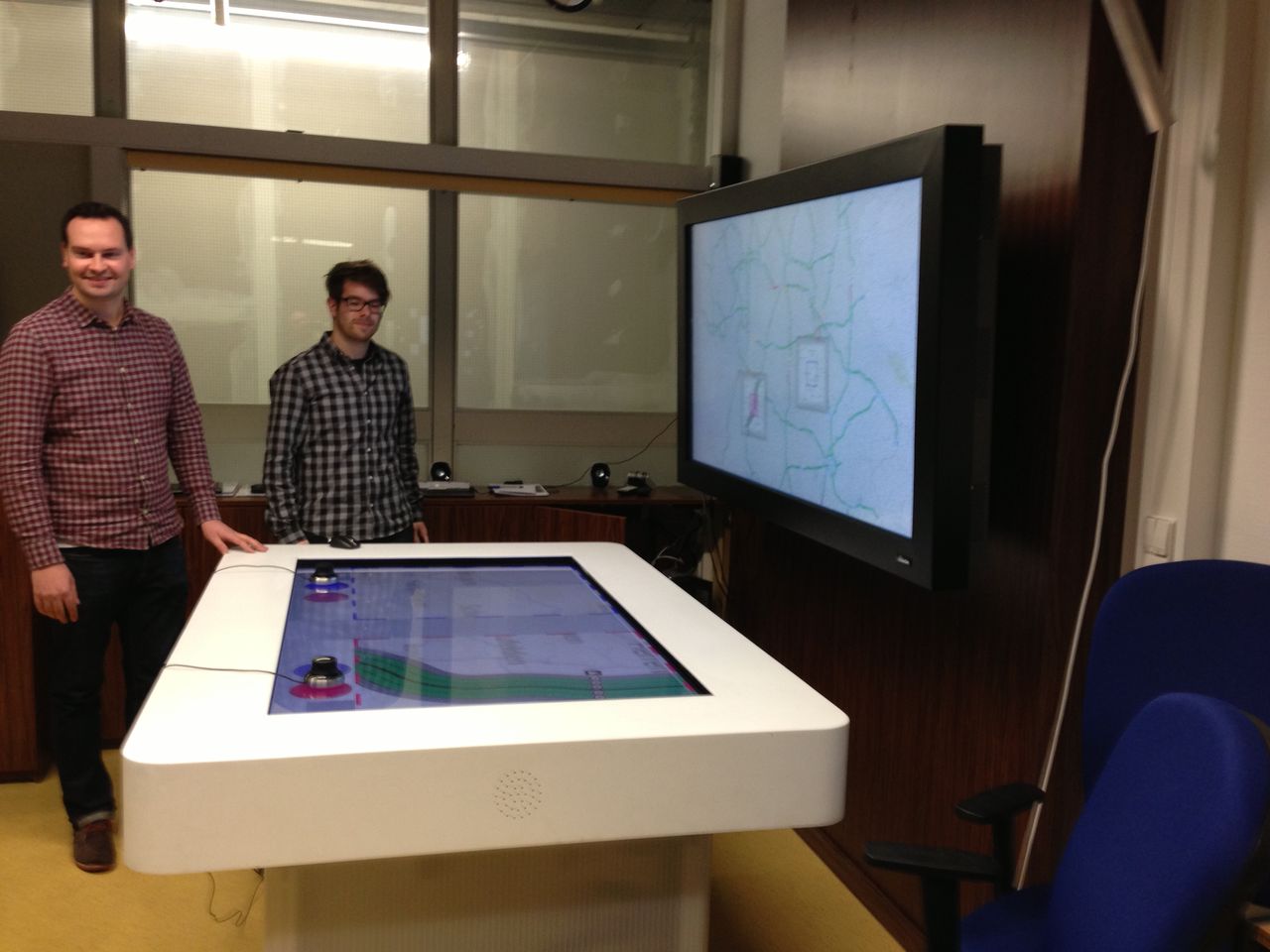 In Konstanz, we visited the Human-Computer Interaction group led by Prof. Harald Reiterer. The range of research and development is very broad. A particular favorite of mine is the work on zoomable multi-display environments (the ZOIL API), and a number of other interesting experiments related to large displays.

 Miguel Nacenta